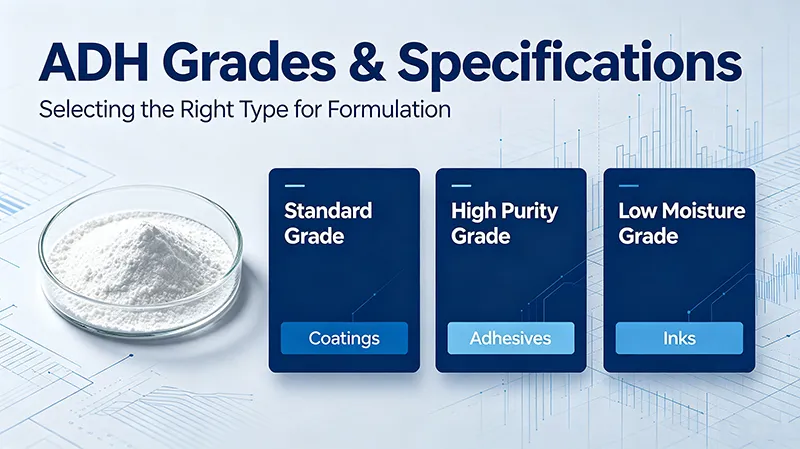
Typical ADH Specification
Parameter | Typical Specification |
Product Name | Adipic Acid Dihydrazide |
Abbreviation | ADH |
CAS No. | 1071-93-8 |
Chemical Formula | C₆H₁₄N₄O₂ |
Molecular Weight | 174.20 g/mol |
Appearance | White crystalline powder |
Purity | ≥98.0% |
Melting Point | Approximately 180–185°C |
Moisture | Typically ≤1.0% |
Solubility | Soluble in water |
Ash | Typically low |
Active Content | ≥98% |
Functional Group | Dihydrazide |
Main Application | Crosslinking agent for ketone-functional polymers |
Key Quality Parameters
1. Purity: High-purity ADH provides more predictable crosslinking and helps maintain consistent coating or adhesive performance.
2. Moisture: Controlled moisture is important for powder handling, storage stability, and accurate formulation.
3. Appearance: Commercial ADH is generally supplied as a white, free-flowing or crystalline powder.
4. Melting Point: Melting-point testing provides an important identification and quality-control parameter.
5. Water Solubility: Good water solubility makes ADH particularly suitable for waterborne polymer and coating formulations.
ADH Application with DAAM
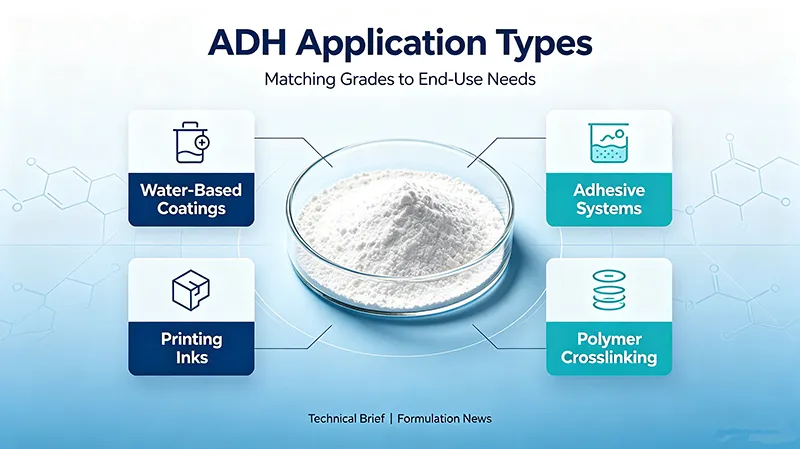
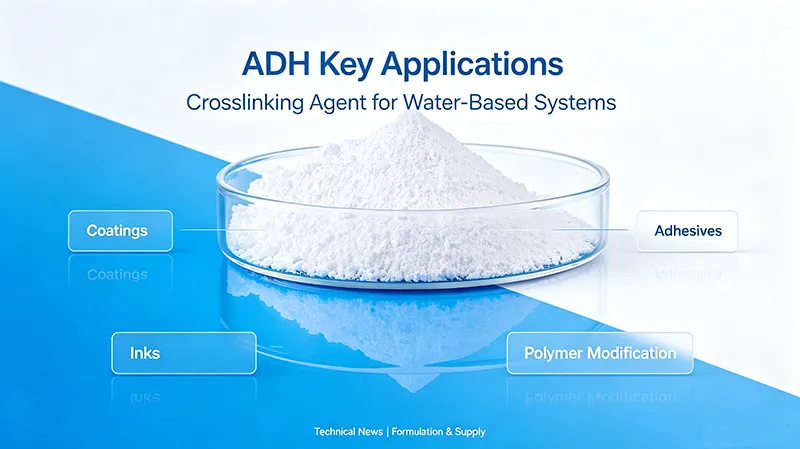
ADH is especially important in DAAM-containing acrylic polymers. DAAM introduces ketone groups into the polymer chain, while ADH provides hydrazide groups that can react with those ketone groups to form hydrazone crosslinks.
This crosslinking system can improve:
· Water resistance
· Chemical resistance
· Film hardness
· Adhesion
· Abrasion resistance
· Mechanical strength
· Blocking resistance
· Overall coating durability
Typical DAAM + ADH System
Component | Function |
DAAM | Introduces reactive ketone groups |
Acrylic polymer/emulsion | Provides the main polymer matrix |
ADH | Reacts with ketone groups and provides crosslinking |
Water | Carrier/dispersion medium |
Other additives | Adjust viscosity, stability, film formation, etc. |



 English
 日本語
日本語 français
 Deutsch
 Español
 العربية
 Türkçe
 italiano
 русский
 português
 Nederland

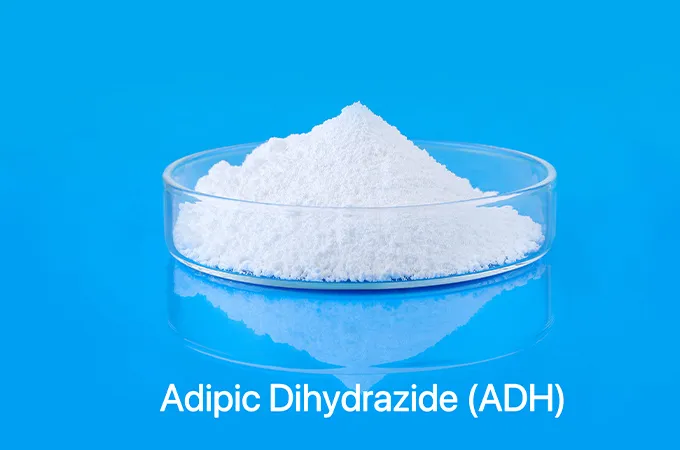
 TDS Adipic Acid Dihydrazide(ADH)