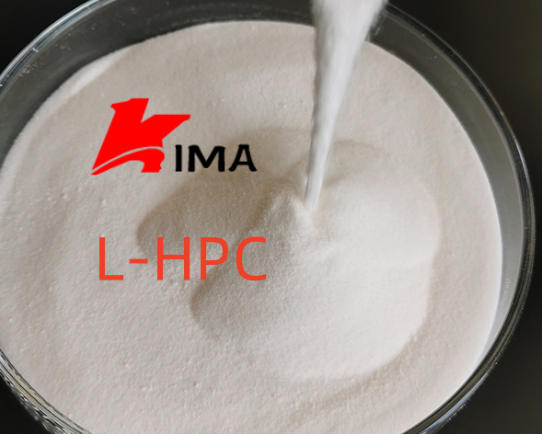
Low-Substituted Hydroxypropyl Cellulose (L-HPC) is a functional polymer derived from natural cellulose and belongs to the class of cellulose ether derivatives. It is a nonionic, water-soluble polymer produced by introducing a small number of hydroxypropyl substituents into the cellulose molecular chain. Compared to common hydroxypropyl cellulose (HPC), L-HPC has a lower degree of substitution, typically around 0.1–0.3, resulting in unique characteristics in its molecular structure and properties. This low degree of substitution has made it important in the pharmaceutical and food industries.
1. Structural Characteristics
1.1. Low Degree of Substitution
L-HPC has a limited number of hydroxypropyl substituents, resulting in a molecular backbone that retains a high number of cellulose hydroxyl groups. These hydroxyl groups impart strong hydrophilicity while maintaining a certain degree of cellulose rigidity.
1.2. Swelling, Not Complete Solubility
Unlike highly substituted hydroxypropyl cellulose (which is completely soluble in water and organic solvents), L-HPC does not completely dissolve in water, but rather exhibits good swelling. This property enables it to form a network structure within the formulation, enhancing tablet disintegration.
1.3. Good Granularity
L-HPC exhibits excellent flowability and compressibility, improving powder processing and facilitating the preparation of uniform tablets and granules.
2. Key Properties
2.1. Disintegrant Function
L-HPC rapidly absorbs and swells upon contact with water, causing tablets to disintegrate quickly and promoting drug release. Compared to commonly used starch disintegrants, L-HPC exhibits higher disintegration efficiency.
2.2. Binder Function
Due to its moderate binding and film-forming properties, L-HPC can be used as a co-binder in direct compression tableting to ensure tablet mechanical strength.
2.3. Excipients and Modifiers
In powder formulations, L-HPC can improve particle flowability and compressibility, helping achieve better drug molding results.
2.4. Biocompatibility and Safety
L-HPC, derived from natural cellulose, has extremely low toxicity and is not absorbed by the body, making it safe for oral medications, food additives, and health supplements.
3. Applications
3.1. Pharmaceutical Industry
Tablet Disintegrant: L-HPC is a common pharmaceutical excipient listed in the International Pharmacopoeia and is widely used in immediate-release tablets, orally disintegrating tablets, and chewable tablets.
Binders and Diluents: In direct compression, L-HPC can increase tablet hardness and prevent breakage.
Controlled-Release and Sustained-Release Formulations: By combining with other polymers, L-HPC can modulate drug release rates.
3.2. Food Industry
L-HPC can be used as a stabilizer, bulking agent, and emulsifier in healthy foods such as chewable tablets and solid beverages to improve taste and stability.
3.3. Cosmetics and Other Industries
In cosmetics, L-HPC can be used as a suspending agent or stabilizer to improve the texture of pastes. In the pesticide and daily chemical industries, it can also be used as a dispersant or suspending agent.
4. Comparison with Other Cellulose Derivatives
Compared to HPMC (hydroxypropyl methylcellulose): HPMC completely dissolves to form a colloidal solution, making it more suitable as a thickener and film-forming agent, while L-HPC is more effective as a disintegrant.
Compared to HPC (hydroxypropyl cellulose): HPC has strong solubility, making it suitable for film formation and thickening. L-HPC, due to its low degree of substitution, is more suitable as a disintegrant.
Compared to starch disintegrants: L-HPC disintegrates faster and is less affected by compression, making it more suitable for industrial formulations.
Low-substituted hydroxypropyl cellulose (L-HPC) is a cellulose ether derivative with a unique structure and excellent properties. L-HPC, a disintegrant, binder, and excipient, is particularly important in the pharmaceutical industry and an indispensable excipient for modern solid dosage forms. Its safe source and diverse functionality will further expand its application prospects with advancements in formulation technology.


 English
 日本語
日本語 français
 Deutsch
 Español
 العربية
 Türkçe
 italiano
 русский
 português
 Nederland